Ants in the kitchen, crawling up your pantry shelves, or marching across your bathroom floor, they’re relentless once they find a way in. Most homeowners reach for chemical sprays, but if you’re looking for a safer, non-toxic approach that doesn’t require a pest control license, diatomaceous earth (DE) is worth your time. It works, costs pennies compared to professional treatments, and you can apply it yourself in an afternoon. The catch? You need to understand what you’re buying, where to apply it, and why it takes patience. This guide walks you through everything you need to know to use diatomaceous earth effectively against ants in your home.
Table of Contents
ToggleKey Takeaways
- Diatomaceous earth ant killer works by damaging an ant’s protective exoskeleton coating, causing dehydration within 24–72 hours without requiring ingestion or poison.
- Always purchase food-grade diatomaceous earth with OMRI certification for indoor use; avoid pool-grade DE, which contains toxic crystalline silica.
- Apply thin, even layers along ant trails and entry points rather than thick coverage, and focus on cracks, baseboards, and gaps where ants travel.
- Moisture activates DE’s effectiveness, so reapply after sweeping, mopping, or rain, and give treatment 7–10 days to show results.
- Diatomaceous earth ant killer works best when combined with removing food sources, sealing entry points, and fixing water leaks to collapse the colony faster.
- Wear an N95 or P100 mask, gloves, and goggles during application to avoid inhaling dust, and keep pets and children away until DE dries and settles.
What Is Diatomaceous Earth and Why It Works Against Ants
Diatomaceous earth is a fine powder made from fossilized algae called diatoms. These microscopic shells have razor-sharp edges, invisible to the naked eye but lethal to soft-bodied insects. When ants walk across DE, the powder clings to their exoskeleton and absorbs the waxy, protective coating that keeps them from drying out. Within 24 to 48 hours, the ants dehydrate and die. Unlike broad-spectrum insecticide sprays, DE doesn’t poison the ant: it works purely through physical desiccation, which means ants don’t develop resistance to it over time.
The real advantage here is safety. Food-grade DE is non-toxic to humans and pets when used correctly. It doesn’t break down into harmful residues and leaves no chemical odor. That said, this is a slow-acting solution, not a spray that kills on contact. You’re asking for patience, not instant gratification.
How Diatomaceous Earth Kills Ants Naturally
The mechanism is straightforward. Diatoms have a silica-based structure with jagged edges that damage the ant’s protective layer. As the ant moves through the powder, those edges nick the exoskeleton’s waxy coating. Over time, usually 24 to 72 hours, moisture evaporates from the ant’s body faster than it should, and the ant dies. This process doesn’t require the ant to ingest DE: contact alone is enough.
One key point: moisture activates DE’s effectiveness. If your home is very dry, the process takes longer. Conversely, in humid conditions, DE works faster because the moisture gradient makes the desiccation effect more pronounced. This is why applying DE in high-traffic ant areas, near entry points, along baseboards, or in wall voids, matters more than blanket coverage.
Choosing Food-Grade vs. Pool-Grade Diatomaceous Earth
Not all diatomaceous earth is created equal. You’ll find two main types at garden centers and online: food-grade and pool-grade (also called filter-grade).
Food-grade DE has a minimum of 90% pure diatomaceous earth and is safe to consume in small amounts, farmers and veterinarians even add it to livestock feed. The remaining 10% is inert clay, iron oxide, and other benign fillers. For ant control in and around your home, food-grade is your only choice. It’s approved for use in areas where food is stored or prepared.
Pool-grade DE is heat-treated at high temperatures and contains crystalline silica, which is toxic if inhaled in significant quantities. It’s designed to filter water, not kill insects around your living space. Avoid it entirely for ant control inside your home. The cost difference is minimal, food-grade runs $10 to $20 per pound, so there’s no good reason to compromise.
When buying, look for labels that explicitly say “food-grade” and “OMRI-listed” (Organic Materials Review Institute). OMRI certification means it’s approved for organic gardening, which signals minimal processing and no hidden additives. Bag sizes typically range from 1 pound to 10 pounds: for a typical home with a moderate ant problem, 2 to 3 pounds is plenty.
Step-by-Step Application Guide for Your Home
Before you open the bag and start dusting, take time to locate where ants are actually entering and nesting. This saves product and increases effectiveness.
Identifying Ant Trails and Entry Points
Watch your ant activity at different times of day. Worker ants follow pheromone trails, invisible chemical markers laid down by scouts. Trace these trails back to where they enter your home. Common entry points include gaps under door frames, cracks around pipes, openings in foundation corners, and gaps between baseboards and flooring. If you have a crawl space or basement, check for trails along the perimeter too.
Mark these spots with painter’s tape or a pencil. Don’t worry about finding every ant: find the main highways. Ants nesting outdoors and foraging indoors will use a few preferred routes. Blocking those routes is far more efficient than trying to poison every ant in sight.
Application Tips for Indoor and Outdoor Use
For indoor application, safety and cleanliness are paramount. Put on nitrile gloves, safety goggles, and an N95 or P100 mask, you don’t want to inhale DE dust, even food-grade. The powder is inert in your lungs, but inhaling any fine dust repeatedly isn’t ideal.
-
Prepare the surface. Sweep and vacuum the targeted area thoroughly. Any dirt or crumbs give ants an alternative path around the DE.
-
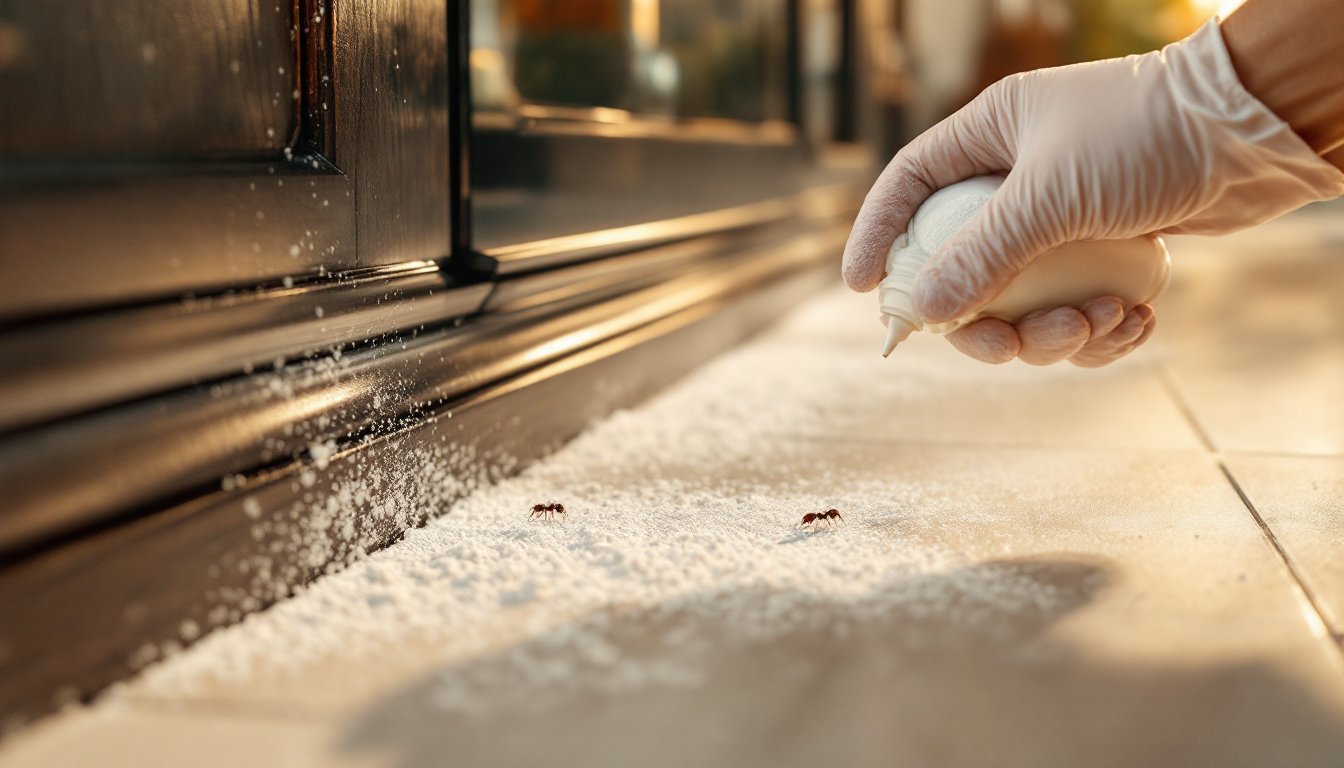
Apply a thin, even layer. Use a shaker bottle, plastic squeeze bottle, or a small brush applicator to dust a thin line, about 1/4 inch wide, along ant trails and entry points. You don’t need thick coverage: a light coat is actually more effective because ants won’t avoid it and will cross through it freely.
-
Focus on cracks and voids. Use a caulking applicator or bulb duster to puff DE into gaps around baseboards, outlet covers, and pipe penetrations. Ants travel through these tight spaces, so DE here blocks their routes.
-
Reapply after cleaning. Any time you sweep, mop, or vacuum the treated area, reapply DE. Moisture from mopping also resets the effectiveness window.
For outdoor application, the stakes are lower, so coverage can be more generous. Dust DE around the perimeter of your foundation, especially near entry points. If you spot an active ant mound in your yard, a light dusting on and around it will disrupt the colony over several days. Outdoor DE washes away with rain, so reapply after storms.
Research shows that food-grade diatomaceous earth can be highly effective when applied correctly to ant colonies and foraging areas. Pairing DE with removal of food sources and water access points, like fixing leaky pipes or sealing up crumb-prone areas, dramatically speeds up colony collapse.
Safety Precautions and Best Practices
Food-grade DE is low-toxicity, but “low” doesn’t mean zero. Follow these precautions to keep your family and pets safe.
Wear appropriate PPE. Dust inhalation is the primary risk. Use a P100 or N95 mask when applying, especially indoors. Gloves and goggles protect your skin and eyes from irritation. If you’re applying to large outdoor areas or in a breezy environment, consider a full respirator mask.
Keep pets and children away during application. Once DE dries and settles, usually within a few hours, it’s safe for pets to walk through treated areas. Food-grade DE isn’t toxic if ingested in trace amounts, but you don’t want your dog or cat deliberately sniffing the powder. Apply when kids and pets can stay in another part of the house.
Store safely. Keep your DE container in a cool, dry place, clearly labeled and sealed. If stored properly, it remains effective indefinitely. Keep it away from moisture sources that could cause clumping.
Avoid inhalation long-term. If you live in the treated area and are exposed to DE dust regularly, wear a mask during reapplication. Chronic inhalation of any fine dust carries respiratory risks, even non-toxic varieties.
Combine with other strategies. DE alone won’t eliminate ants if food and water sources are abundant. Wipe down counters, don’t leave pet food out overnight, fix leaky pipes, and seal food in airtight containers. Clean homes with reduced food debris are far less attractive to foraging ants. Think of DE as the final barrier, not the only defense.
Monitor results. Give it 7 to 10 days before declaring victory. You should see a dramatic drop in ant activity within that window. If ants persist, recheck entry points, there may be another route you missed.